
by Amy Ding
From the Archives: this blog post is taken from a student exchange report from 2017
Exchange University: Maastricht University SBE
The excitement starts as soon as you decide to apply for an overseas exchange. Where will I go? What are the people like? Is the weather cold? Can I afford it? Is there a scholarship I can for?
As soon as I got off the train in Maastricht I was absolutely engulfed with the history surrounding me. Everything you see in magazines, travel brochures, and on TV, is right there before your very eyes and you are living it! It is almost overwhelming. The curving, narrow, cobbled streets with high Dutch-style buildings of purple brick that crowd in on each other; the bare Winter trees that hold the misty rain; tell you that you have arrived and invite you to explore.

I walked to the University of Economics, and again was enthralled with the sheer majesty of the buildings; ancient on the outside, but quite modern on the inside. There were no leaves on the trees at this time so I would have to wait a few months for Spring to cover the place with green and soften the lines. Another thing that struck me was the cold outside was replaced everywhere you went, with the warmth inside. I needed to explore! €80 (approx. $120NZ) bought me a second-hand bike with three gears. You don’t need many gears here in Holland because the land is so flat. This purchase was a must because it reduced my travel time immensely. Cycling on the “wrong side” of the road was a mission to start with, especially since they have dedicated cycle lanes. Motorists are extremely conscious of cyclists though, and give way to them immediately. Everyone signals and everyone obeys the rules.
You can’t go far in Maastricht without being in the vicinity of a church which is much the same throughout Europe. Many years ago, religion must have played a huge part in their lives as the evidence is there for all to see. No matter where you turn there is another church in front of you. Each church seems to compete against the next to be bigger and more ostentatious than the other, reaching higher and higher into the sky as if trying to be closer to heaven.
Tulips are beginning to be sold in shops now and of course they are not only beautiful but really cheap. The ones I bought last week are still going strong, reminding me that spring is just around the corner. The sun broke through yesterday so that’s another positive sign that the temperature will begin to rise. Since I’m here for five months I will experience winter in February right through to summer in June.
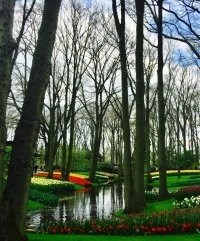
In the middle of Maastricht there are two market places surrounded by restaurants and dozens of small cafes but it’s hard to find a supermarket like New World or The Warehouse. And I haven’t seen a petrol station yet!!! – everybody bikes everywhere!!
Everyone is gearing up for the Festival to be held over a few days to mark the beginning of Spring. Everyone (and I mean everyone) dresses up in gaudy costumes and parades around for all to see. Quite an event I’m looking forward to.
The Maastricht Carnival is something everyone should experience! Wow! When they say it lasts for four days – that’s exactly what it does, but they forgot to say that it goes for four nights as well. The carnival never stops to take a breath day or night for the whole four days!! There are floats by the thousand, with hundreds and hundreds of bands playing day and night without a stop. The whole town dresses up for the week and parades up and down the streets singing, dancing and drinking. There’s no such thing as an alcohol-free zone. All the streets were teeming with people having fun. The crowds were made up of families which made everything safe without any drunken trouble or nastiness. The local pubs did a roaring trade. The shops were sensible and closed for the whole time. The only ones to open were the food stores.

I travelled to Brussels for a three day visit and thoroughly enjoyed the experience. Again, they centre their city around a large market square flanked by grandiose municipal buildings. Most European cities have this configuration because they all seem to have had their origin around a river or some other physical prominence in the area. Most of Europe of course was conquered by the Romans who had to build forts to defend the towns and cities from other intruders. The many cobbled streets and fortifications are evidence of that.
My visit to Paris was a once-in-a-lifetime experience.

There are no words that can describe the size and grandeur of the Louvre. No photograph can capture the sheer physicality of the buildings. It covers many, many city blocks and dives eight storeys underground as well. The closest thing to a labyrinth I have ever seen. Very easy to get lost in there. Of course, I headed straight for the Mona Lisa and since it was late at night I had a great view because the daytime crowds were not there. From the photos and brochures, you would think the painting to be quite large like many of the other paintings on display, but she’s quite small.
The bus tour took me to all the main sightseeing attractions and along the way I was overawed by the number of huge statues that line each street and adorn the monuments. The Champs-Elysees was an amazing street and the Arc de Triomphe straddling the road was magnificent.
When you approach the Eiffel Tower it grows larger and larger as you get within its grandeur, and from its latticed framework, you look back and see the skyline dominated by the mammoth Ferris Wheel at the other end.
You can never start planning too early because there is an awful lot to do. Where do you start?
- Go to the University of Waikato’s website and search for overseas exchange universities to find which ones would accept cross-crediting of your degree papers. That should narrow down your choice of overseas universities. Choose the one that best suits your individual needs, but make sure it caters for English-speaking students.
- Passport up to date for the entire trip. Your visa requirements are usually looked after by the host university as it needs to be an extended visa and if you only have an Asian passport and want to travel to the UK, you need to apply early for a special temporary visa that is very expensive!
- Money in the bank for host university administration costs as you need to have the required funds in the bank to support yourself for the whole semester. You just supply a financial statement from your bank to verify you have the funds.
- Start and end dates confirmed. Arrive a few days early to acclimatise yourself and rest.
- Flights and transport to the airport, and transport from the host airport to your accommodation.
- Accommodation dates and cost. You can arrange your own, (expensive) but the hosts can place you in a student hostel if you prefer.
- Host university requirements: Lots of documentation needed with scanned documents sent first, followed by originals later when you have been accepted.
- Health insurance is compulsory if the host country does not have reciprocal hospital cover with NZ, like Australia and Britain do. Couple your health insurance with your comprehensive travel insurance as it is cheaper. Search the web for cheap options. Southern Cross, Webjet, One Cover etc.
- Be prepared for a long, long set of flights because travelling from NZ is long and arduous to most other places in the world. I flew 12 hours from Auckland to Hong Kong and then after a 4 hour wait in Hong Kong, flew another 11 hours to Amsterdam. It was then, a one-and-a-half-hour train ride from Amsterdam to Maastricht. A long, long time to travel especially with luggage.
1) TRANSPORT:
a) Bus – local, buy a cheap bus card that will last for your entire stay.
Inter-city, use FlixBus app. You must book online.
b) Train – You can buy train passes that allow multiple destinations. (economical)
c) Uba – cheapest way to get around the bigger cities.
d) Walk – most destinations are flat and accessible. Google map is essential.
e) Taxi – most expensive to use.
2) COMMUNICATION:
Ease of speaking
i) Netherlands 10/10 extremely good oral and written communication. Very blunt but honest.
ii) Belgium 8/10 very good
iii) Luxemburg and Austria 7/10 not too bad
iv) Germany 6/10 harder but ok
vi) Czech Republic 5/10 harder
vii) France and Italy 2/10 Very little tolerance for those who don’t speak their language.
3) WHAT DID I LEARN?
- That the threat of terrorism is treated very seriously in Europe with armed troops and police everywhere.
- European history is thousands of years old and tourism is the basis of many livelihoods.
- The cleanliness of the cities range from really clean (Luxemburg), to really filthy – ???
- Most major cities are divided into two parts – old and new.
- They have little need for farm fences as their animals are all housed inside and rarely seen.
- The transport systems are efficient and very effective in moving the masses.
- Even though prices fluctuated from country to country, the overall impression was that commodities are much more expensive in Europe. (except alcohol).
- The Dutch don’t display large cuts of meat like we do – they seem to mince everything!
- Their bread and butter is to die for though!
- Mention you’re a Kiwi and they think straight away of two things – Rugby, and the fact that they would love to visit because they’ve heard great things about us.
I had a fantastic, breath-taking, fulfilling experience about how other cultures live, but the main thing I will take away is an appreciation of how wonderful New Zealand is.
 Waikato Global Experiences Blog